
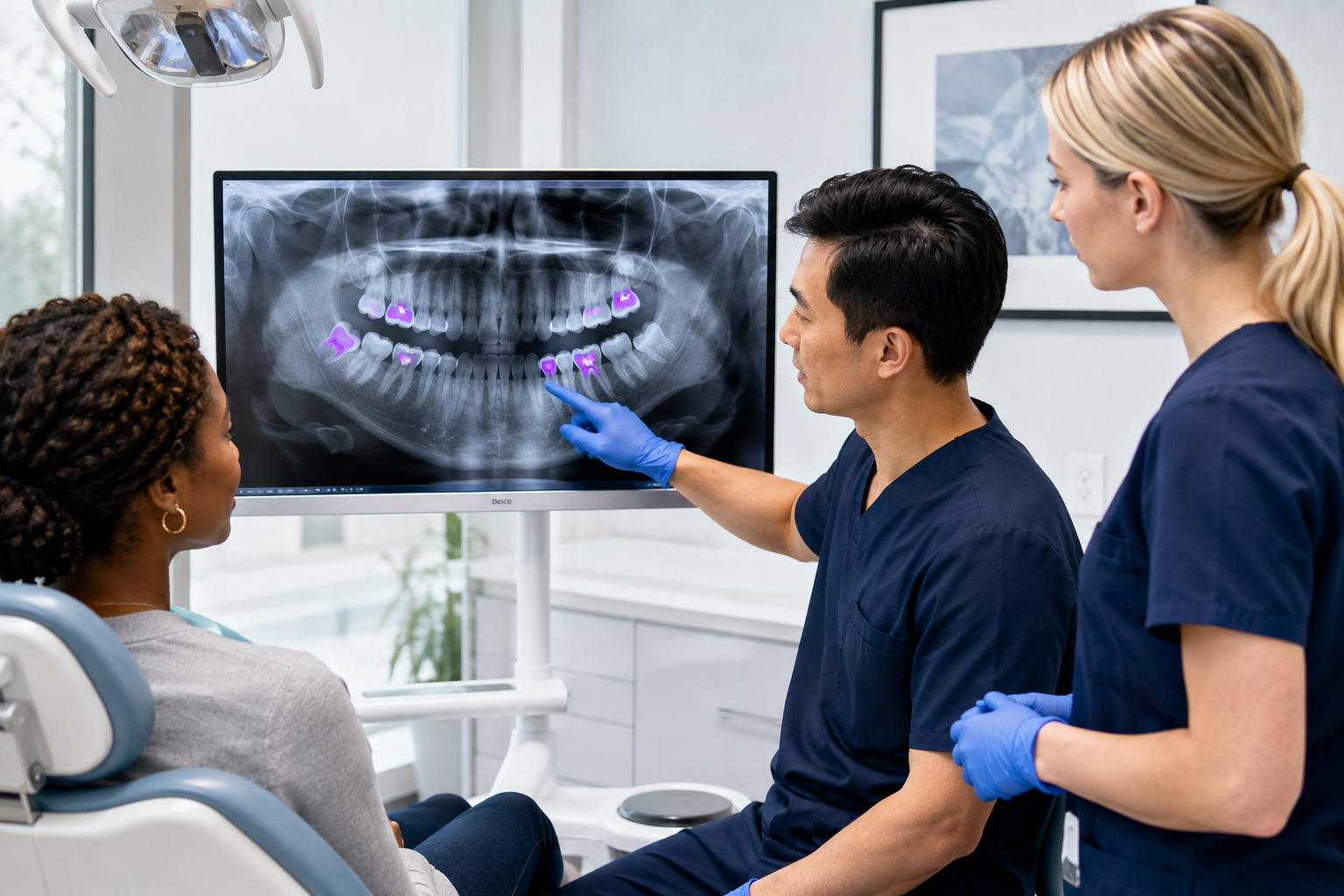
Cavities do not always cause pain when they first begin. In fact, early tooth decay can develop quietly, sometimes in areas that are difficult to see during a routine visual examination. By the time sensitivity or discomfort appears, the decay may already have progressed. This is one reason dental technology continues to evolve, with artificial intelligence becoming an increasingly interesting tool for detecting potential problems on dental images.
For patients visiting Kitchener Dentist Fairway Dental, advances such as AI-assisted dental imaging may provide dentists with another source of information when examining teeth for signs of decay. However, AI does not replace the dentist. Instead, it can serve as an additional tool to support clinical judgement and help dentists review dental X-rays more carefully.
How Are Cavities Normally Diagnosed?
Dentists use several methods to check for cavities. A dental examination typically includes visually inspecting the teeth, asking about symptoms, evaluating areas that may be sensitive or damaged, and reviewing dental X-rays when appropriate.
X-rays are particularly useful because some cavities develop in places that are difficult to see directly, including between neighbouring teeth or underneath existing dental work.
The challenge is that very early changes on an X-ray can sometimes be subtle. Dentists are trained to recognize these changes, but AI-assisted imaging software can provide an additional set of digital “eyes” for reviewing images.
How Does AI Detect Possible Cavities?
Dental AI systems are generally trained using large collections of dental images. The software learns to recognize patterns associated with conditions such as tooth decay and can then analyze new images for similar features.
When reviewing a dental X-ray, certain AI systems can highlight an area that may deserve closer attention. The dentist can then examine the area, compare it with previous X-rays, perform a clinical examination, and determine whether there is actually a cavity.
Artificial intelligence is already being studied and used in dentistry for analyzing radiographs and other dental images. The American Dental Association describes AI applications that can help detect dental caries and other oral conditions. Importantly, the technology is intended to support dental professionals rather than make independent treatment decisions.
Can AI Really Find Cavities Earlier?
Potentially, yes.
One of the most promising benefits of AI-assisted dental imaging is its ability to highlight small or subtle changes that might otherwise require particularly careful examination. Research published in the Journal of the American Dental Association continues to evaluate how accurately AI systems can identify demineralized areas and dental caries.
That does not mean every area highlighted by AI is a cavity. Different conditions, image quality, and normal variations in tooth structure can influence what appears on an X-ray.
The dentist still needs to interpret the image alongside your dental history, symptoms, and clinical examination.
Think of AI as an assistant rather than an automatic diagnosis.
Why Earlier Detection Matters
Cavities begin when acids produced by bacteria gradually remove minerals from tooth enamel. In the earliest stages, the tooth may not hurt at all.
Finding a suspicious area early gives your dentist an opportunity to assess whether the tooth needs treatment or simply closer monitoring.
Depending on the location and severity of the decay, early management may involve improved brushing and flossing, fluoride treatment, dietary changes, or a small filling. More advanced decay may require a larger restoration, root canal treatment, or other dental procedures.
This is why routine examinations remain important even when your teeth feel completely normal.
At Kitchener Dentist Fairway Dental, regular examinations allow the dental team to look for gradual changes over time rather than waiting until a dental problem becomes painful.
Symptoms of a Cavity to Watch For
Although early cavities frequently have no obvious symptoms, more advanced decay can cause noticeable changes.
You should consider scheduling a dental examination if you notice:
- Sensitivity to cold, hot, or sweet foods and drinks
- Toothache or unexplained discomfort
- Pain when biting or chewing
- A visible dark spot or small hole in a tooth
- Food repeatedly becoming trapped between particular teeth
- A rough or damaged area that you can feel with your tongue
- Persistent sensitivity in one specific tooth
These symptoms do not always mean you have a cavity, but they are worth having evaluated.
AI Is Helpful, but Prevention Still Matters More
Technology can improve the information available to dentists, but preventing cavities remains far better than simply detecting them earlier.
Good daily habits continue to make the biggest difference.
Brush your teeth twice a day using fluoride toothpaste and clean between your teeth every day with floss or another interdental cleaning method recommended by your dental professional. Limiting sugary snacks and drinks can also reduce the time teeth are exposed to cavity-causing acids.
Regular dental visits are equally important. Your dentist can check areas that are difficult to inspect at home, monitor previous dental work, and determine when dental X-rays are appropriate.
AI cannot compensate for years without preventive care.
Should You Be Concerned About AI Making Dental Decisions?
AI in health care is subject to increasing attention regarding safety, transparency, and appropriate human oversight. Health Canada has published guidance concerning machine-learning-enabled medical devices and specifically emphasizes the performance of the human-AI team rather than viewing the technology in isolation.
For patients, the key point is simple: technology can provide additional information, but your dentist remains responsible for evaluating your individual situation and recommending appropriate care.
If an AI system highlights something on an X-ray, that finding should be considered alongside the dentist’s examination rather than treated automatically.
The Future of Cavity Detection
Artificial intelligence is unlikely to replace your dentist, but it may make dental imaging increasingly useful as technology improves. AI could help identify subtle areas, compare images, and support consistent review of dental X-rays, contributing to earlier detection.
The most effective approach, however, remains a combination of good technology, professional judgment, and regular preventive dental care.
If it has been a while since your last dental examination, or you are experiencing tooth sensitivity, discomfort, or another dental concern, contact the office at 519-893-9494 to arrange an appointment and keep your smile on track with Kitchener Dentist Fairway Dental.
DISCLAIMER: The advice offered is intended to be informational only and generic in nature. It is in no way offering a definitive diagnosis or specific treatment recommendations for your particular situation. Any advice offered is no substitute for proper evaluation and care by a qualified dentist.